
Growth and resilience in the year of the polycrisis
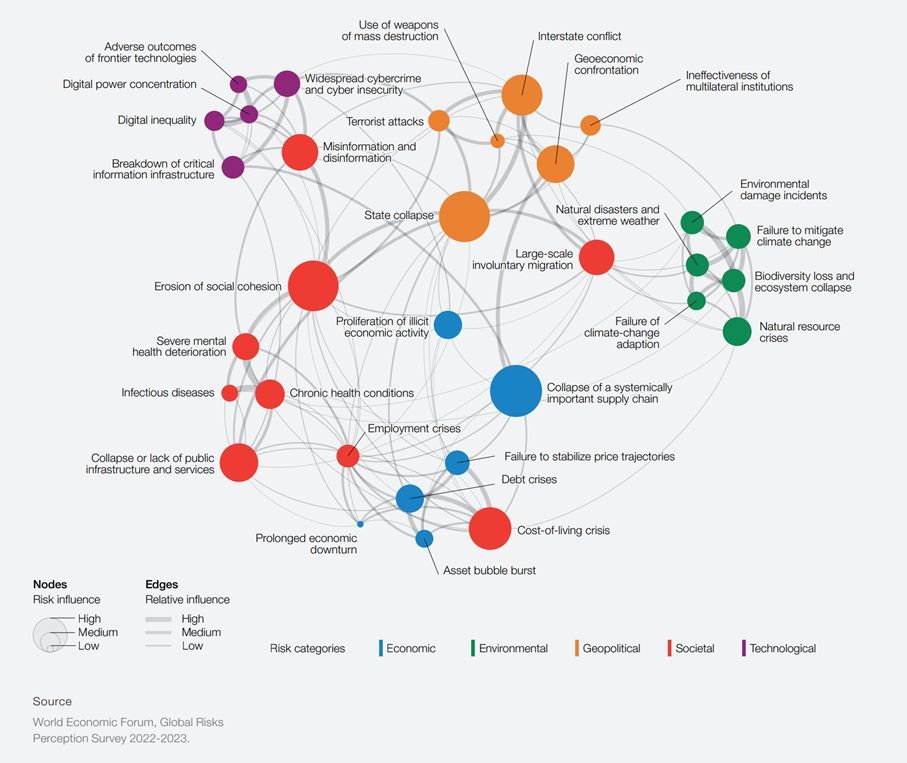
This year's Global Risks Report by the World Economic Forum (WEF) has shown a volatility of the current risk landscape and the interconnectedness of the key risks identified impacting how companies will manage their risks in the future. Unless the world begins to cooperate more effectively on climate mitigation and adaptation, progressive global warming and environmental degradation over the next 10 years will be unpreventable, the report says.
“Climate and human development must be at the core of concerns of global leaders, even as they battle current crises. Cooperation is the only way forward.” - Saadia Zahidi, Managing Director, World Economic Forum
After decades in which globalization produced unprecedented growth around the globe and a strong global middle class, we are now seeing most of the world's eight billion people increasingly worse off in areas such as educational attainment, life expectancy, economic prosperity, and security. This is compounded by a cornered Russia that has evolved from a global player into a major and far-reaching threat to Europe, the United States, and other countries. The resulting global divergence will create tensions that threaten to exacerbate the cascading effects of the pandemic and make it difficult to coordinate necessary responses to common challenges, including strengthening climate action, strengthening digital security, restoring livelihoods and social cohesion, and addressing competition in space.
What is behind the term "polycrisis"?
The crises of the last decades were often characterized by one single systemic risk. The term polycrisis refers to the presence of multiple global crises occurring simultaneously. The polycrisis perspective calls for a global systems approach to address the inescapable linkages between different sectoral, economic, and environmental crises. According to the WEF, a polycrisis is "a situation where different risks collide and their interdependency is acutely felt". With inflation rates and the cost of living for households and businesses rising worldwide, the links between global economic shocks and their impact on the global political and security risk environment are clearer than ever.
How to turn things around?
The pandemic has exposed vulnerabilities in the global economy and the disruption effect it has had on vulnerable communities has impacted poverty, creating global risks. The world has also faced a global financial crisis, extreme poverty, and other economic risks. These have been further compounded by geopolitical tensions, fuel crises, increasing inequalities and health systems that are unequally distributed across the world. Taking a global view and tackling risks associated with unforeseen future shocks is critical. Different countries have different levels of capacity to respond to the crisis, with some developing countries far less well equipped than developed countries. This has created a need for collective strategies that take into account the global financial system and respond in a collaborative way. Mitigating the impact of the polycrisis requires understanding that there will be no single shared narrative and taking a global view is essential and recognizes the integral role of geopolitics in shaping a strong response to the polycrisis.
Resilience matters
With the onset of the polycrisis, growth and resilience have become two key components for success to stay one step ahead of the dangers posed by a polycrisis. Resilience strategies have become even more important in order to address multiple risks. According to a McKinsey article from October 2022, companies must rethink their strategies to develop the resilience needed in these critical times via a perceptive reaction to present issues, foresight to foresee the next wave of disruptions, and aptitude for adaptation that will establish the organization on a foundation for sustainable growth. They must strengthen their core capabilities and become more resilient. Company leaders must also focus on growth, requiring anticipatory governance that looks at potential risks and opportunities. New approaches are need and they must be suitable for the current environment. An increased focus on regeneration, circularity and climate change mitigation strategies can help create economic models that are sustainable in the long run. Investors have a key role to play because their investments could make possible a just and sustainable world.
Transformative investments to tackle global challenges
The concept of transformative investment to tackle global challenges is gaining traction in both policy and investment worlds. This shift is driven by the realization that business as usual will not deliver the necessary solutions to pressing global issues such as poverty, inequality, and climate change. Transformative investments aspire to enhance global economic governance, enabling an international economic environment to promote global development, and supporting national development efforts. Through this approach, countries can create a more coherent world trade system that brings huge gains for all involved. Transformative investors tackle global challenges by seeking to create a more equitable and effective system that promotes sustainable development while respecting the different national policies of each state. They also seeks to transform current sectors and systems so that they can better address the issues of climate change and inequality while helping to create a more sustainable future. However, it requires the collaboration of organizations, governments, other stakeholders, and international financial institutions in order to share resources between different countries. Only through united efforts, the global economy may become strong and resilient enough to withstand whatever challenges may come its way in the future.