
Remote work is here to stay

Spatial commitment in relation to work has become obsolete. Measuring productivity and the quality of work is independent from the place of work. With the rise of the Internet, work can take place anywhere. All you need is an online connection and ideally a laptop to be perfectly mobile.
Until recently, companies were reluctant to give employees freedom of movement. The coronavirus just revealed what has always been possible and probably appreciated by many employees. Alvin Toffler was one of the most popular futurists of the 20th century and he noticed early on that one of the most unproductive things about our time is moving millions of people to work areas every morning and back home every evening. Surprisingly, technology has evoloved in a way that commuting has become dispensable for many professions. Nontheless, that kind of goes past a lot of leaders.
A glimpse into the history of remote work
If you thought that remote work was a totally new trend, then you are wrong. In fact, the term telecommuting was first used by NASA Engineer Jack Nilles in 1973. Even before the PC, advanced distant work strategies were planned and organizations started implementing them after 1999. In 1979, five IBM representatives were permitted to telecommute as an expertiment.
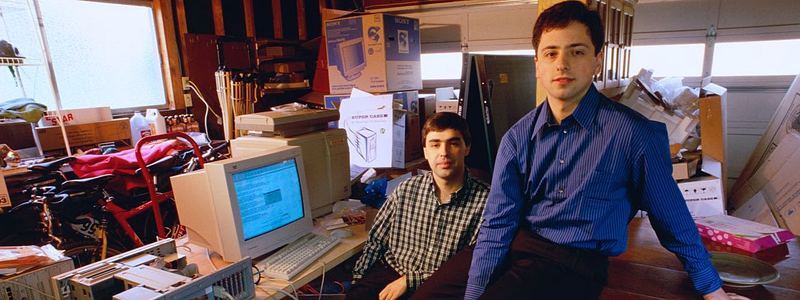
Interestingly, we praise and admire today’s most successful businesses à la Microsoft, Apple and Google (see image below with Larry Page and Sergey Brin). They made their first steps towards multi-billion dollar companies by working from home until achieving a certain degree of cash flow stabilization. So, the concept of remote woking is not new and productivity has never been a question of workplace. Trust and the existence of a remote working culture play important roles.
Trust matters — where you work shouldn’t
Digital transformation refers to the transition of an economy and society shaped by analog technologies into the age of digitization. In contrast to digital disruption, which describes the radical change of markets, digital transformation is an evolutionary process. Employees are the most valuable assets an organization has and yet many leaders tend to neglect this indisputable truth. Their loyalty, abilities and experience cannot be replaced. Placing emphasis on investing in a modern work culture, where everyone feels valued, supported and most importantly trusted, is an underrated source of success for an entire organization. Why do many still have a hard time in letting remote work be part of their work culture?
Remote: The Future of Work is Now — A webinar not to miss
Got wifi? Probably, the most common question remote workers nowadays need to ask before being set and ready to work from all over the world! Technology has made possible incredible progress in work culture.
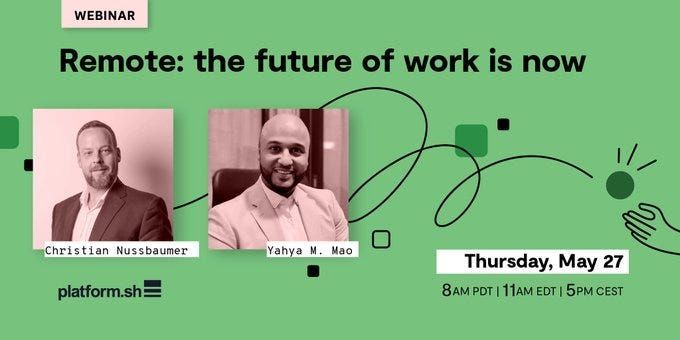
My network of business contacts, colleagues and friends is filled with tech-affine and trend-conscious people. Christian Nussbaumer is a great example of digital nomads with whom I often exchange ideas and viewpoints on a daily basis. We discuss to what extent the way we work is evolving into an agile, productive, tech-driven, transformative and location-independent work culture. During the upcoming webinar Remote: The Future of Work is Now (Thu, 27 May, 2021 — Time 17:00 CEST / 08:00 PDT) sponsored by Platform.sh, we will reveal the difficulties and chances of remote work in an organizational, operational, cultural, and human context. Both of us have made profound experience working remotely and we look foward to share practical advice to accelerate the digital transformation of your business and prepare your organization for the future of work — which is now.
Learn about overcoming the challenges and leveraging the opportunities of remote work! Accelerate the digital transformation of your business–now! Save your spot: https://platform.sh/videos/2021/the-future-of-work-is-now/
Related reading
ContinousNEXT: Embracing the era of post-digital tranformation

Transforming from an oil-driven to a data-driven economy: The COVID-19 pandemic is a chance to rethink decades of heavy reliance on oil reserves