
Web3 And The Vision Of A Decentralized Online Ecosystem
Web3 stands for a possible next stage of development of the Internet and is intended to make the World Wide Web more decentralized and democratic thanks to blockchain technology.
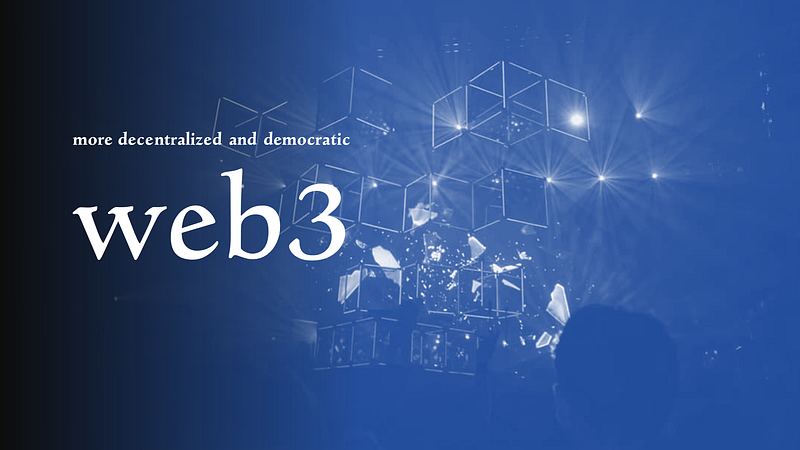
After the metaverse, Web3 is another buzz term in industry and business causing a stir and is supposed to shape the future of the Internet — a permissionless, open source and increasingly decentralized place.
Web 2.0 emerged around 1999 with the advent of social networking platforms, digital advertising, blogs, and various other services that allow users to interact with the Internet. Web 1.0 was built on decentralized, community-driven protocols, and the user demographic was mostly content consumers rather than content creators. The founder of the World Wide Web himself, Tim Berners-Lee, who laid the foundation for how we use the Internet today with the Hypertext Markup Language (HTML), has been criticizing for several years that the World Wide Web and the infrastructure that keeps it running are in the hands of a few large corporations. In particular, it harms users, who pay for many services by giving up their data. Consequently, they are watched by advertising companies while surfing and can hardly find alternatives to the big platforms. However, with Web3, users will be able to regain control over their data and experience a truly decentralized web.
The concept, although currently many ideas and visions are circulating around, refers to the advanced state of the World Wide Web and is characterized by a blockchain-based decentralized ecosystem where users can interact without worrying about central data storage. in fact, data will be stored in decentralized cloud networks and offline storages. In this third generation of the Internet, devices will connect to a decentralized network rather than relying on back-end databases. made possible by blockchains and smart contracts that offer the ability to securely and securely transfer valuable information without intermediaries. Web3 is expected to change the entire user experience by focusing on data connectivity, but what sets it apart is the blockchain-based platform. The vision of Web3 is to offer us a fairer Internet with seamless services, fewer data leaks, more freedom and the ability to run applications anywhere in the world on a decentralized platform. A combination of promising technologies such as blockchain and artificial intelligence will make Web3 even more valuable.
Web3 — Too good to be true?
Proponents of this new paradigm say it will enable digital ownership of content and art and put an end to big tech companies like Amazon and Facebook. At the same time, there is no shortage of skeptics and critics who believe the system is fundamentally flawed and has the potential to undermine the freedom and openness of the Internet. It is perfectly rational to want to create a more decentralized technology stack and strive for a more egalitarian internet, a more just society, and a better world. However, Web3 is not the golden road to this world, it is still the technological embodiment of this empty desire to find a messianic solution to all of our problems.While decentralization is a key tenet of Web3, critics point out that some centralization is unavoidable. Web3 is a cryptographic terminology used to describe a decentralized version of the Internet that will run on public blockchains like Ethereum. Web3 may reduce the power of the biggest Internet companies — Amazon, Google, Microsoft and Facebook — and give it back to users, but as Kevin Werbach, a Wharton professor and author of Blockchain and the New Architecture of Trust, points out, the technology may not be as advanced as the hype and the current popularity of digital assets still poses no threat to big tech. Other critics argue that Web3 will never be a truly decentralized version of the Internet, especially as more venture capitalists are investing in space in an attempt to monetize it and control it in the long run. Jack Dorsey, former CEO of Twitter, said Web3 on Ethereum has been “centralised” due to heavy investment by venture capitalists. Dorsey’s repeated comments have sparked a confrontation between him and several venture capitalists who have poured billions of dollars into the crypto space and Web3 this year.
The undeniable criticism of cryptocurrencies and Web3 is often ignored or attributed to redirection, with some followers inciting verbal attacks and threats against those who openly oppose it. Even with increased skepticism, the crypto space and Web3 continue to grow rapidly. Skepticism about Web3 and cryptocurrency is growing and people are finally starting to listen Cryptocurrency skeptics have tried to warn the public that crypto is a Ponzi scheme and Web3 is a fake decentralization that cannot fix a network that is not broken. Many of the so-called web3 solutions are not as decentralized as they seem, and others have yet to prove that they are sufficiently scalable, secure, and accessible to the mass market. Web3’s goal of a decentralized and democratic Internet is a noble one, but as governments around the world impose restrictions on the Internet, this can be a daunting task. Having made astronomical profits, Web3 has become an undeniable idealistic crusade on how blockchain technologies will rebuild the centralized web.
What to expect?
The innovation spirit of Web3 experiences a damper with blockchain and related technologies that seem to be the pillar on wich the future of the Internet is built. However, diversity and alternatives drive innovation. We need to open up new ways of thinking and using. Blockchain and related technologies should be just one of many pillars on which the future of the Internet is built. Startups and investors should push and fund other technologies and ideas even if they do not experience the same hype as blockchain and crypto technologies. Without doubt, many promising concepts exist and they can also make the World Wide Web a place that is more decentralized, democratic and free. Web3 must be a place dominated not just by a handful of big companies, but by the users.